
AI for Chiropractors: The Basics
By Dr. Jeff Langmaid · · 10 min read
Chiropractor and Co-Founder of The Smart Chiropractor
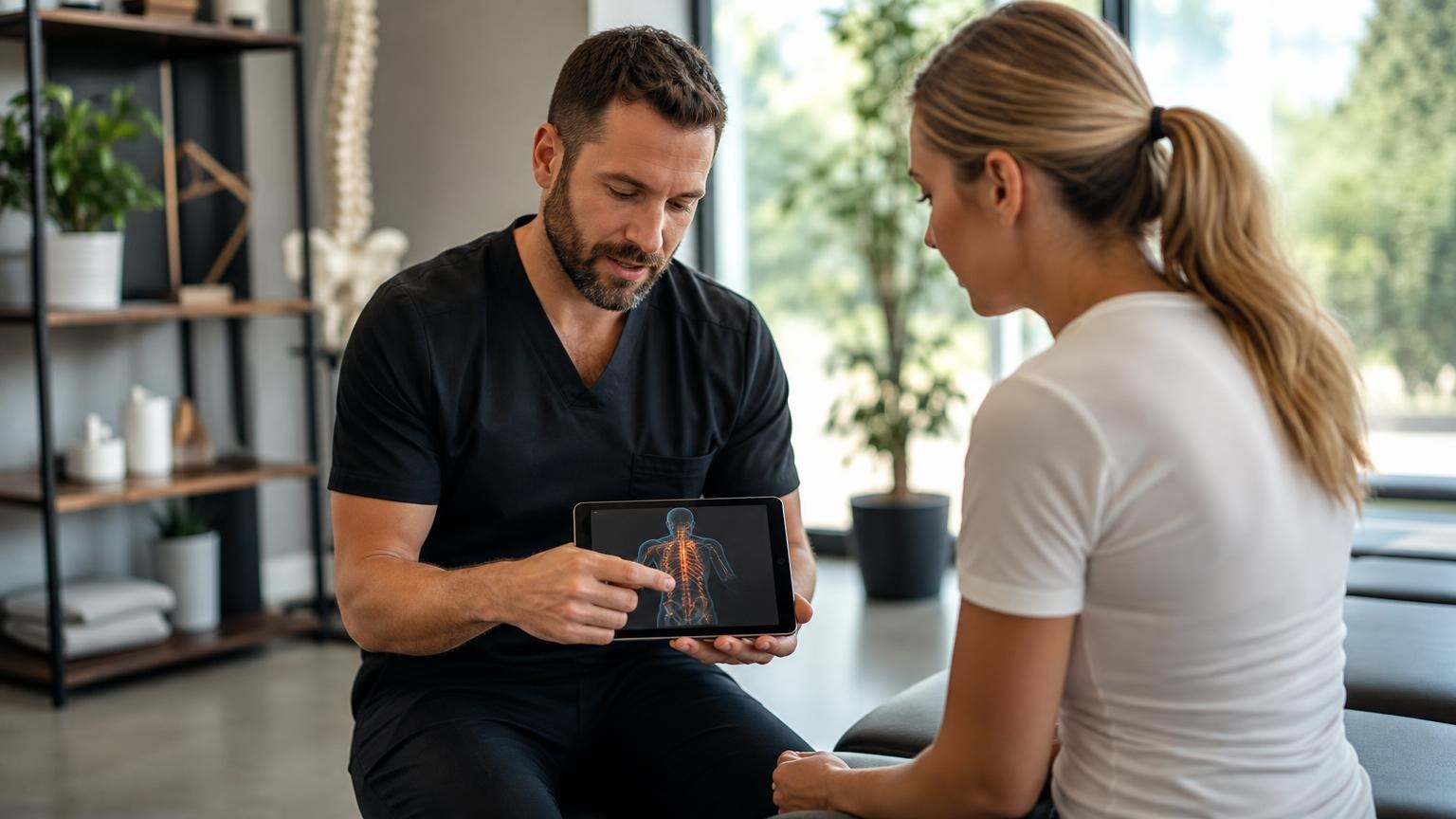
Most chiropractors got into this profession because they wanted to help people with their hands, not because they dreamed of spending hours on documentation, scheduling logistics, or deciphering X-rays pixel by pixel. But the administrative side of running a practice has ballooned over the past decade, eating into the time you could spend with patients. That tension between clinical care and business management is exactly where artificial intelligence is starting to make a real difference. AI tools built for chiropractic practices aren't about replacing the adjustment or the relationship you build with patients. They're about handling the repetitive, time-consuming tasks that pull you away from the table. Whether you're a solo practitioner or running a multi-doctor clinic, understanding how AI fits into your workflow is no longer optional: it's quickly becoming a competitive necessity. The practices that figure this out first will spend less time on busywork and more time doing what they trained years to do.
Defining Artificial Intelligence in the Chiropractic Context
The term "AI" gets thrown around loosely, and that creates confusion. In a chiropractic setting, artificial intelligence refers to software that can learn from data, recognize patterns, and make recommendations or take actions without being explicitly programmed for every scenario. It's not a robot performing spinal adjustments. It's a set of tools that process information faster and more consistently than a human can, especially for repetitive analytical tasks.
Think of it this way: your clinical expertise is irreplaceable. What AI does is handle the cognitive grunt work, like flagging anomalies on imaging, predicting which patients are at risk of dropping off their care plans, or drafting your SOAP notes in real time. The goal is augmentation, not replacement.
Machine Learning vs. Routine Automation
There's an important distinction between basic automation and true machine learning. Automation follows fixed rules: "If a patient hasn't been seen in 30 days, send this email." That's useful, but it's not AI. Machine learning, on the other hand, improves over time. A machine learning model might analyze thousands of patient records to identify which combination of factors (age, complaint type, visit frequency, compliance history) best predicts whether a patient will complete their care plan. The more data it processes, the sharper its predictions become.
Both have a place in your practice. Automation handles the predictable stuff. Machine learning tackles the complex, pattern-heavy problems where human intuition alone can miss things.
How AI Complements Manual Adjustments
No algorithm is going to replace the feel of a subluxation under your hands or the clinical judgment you develop over years of practice. AI's role is upstream and downstream of the adjustment itself. Before the patient hits the table, AI can help you analyze imaging, identify risk factors, and build a more targeted care plan. After the adjustment, it can track outcomes, suggest modifications, and keep the patient engaged between visits.
The best way to think about AI for chiropractors is as a clinical and administrative assistant that never calls in sick, never forgets a detail, and gets better at its job every month.
Enhancing Clinical Decision Support and Diagnostics
This is where AI gets genuinely exciting for clinicians. Diagnostic support tools are moving beyond academic research and into practical, clinic-ready applications. The common thread is speed and consistency: AI can analyze data in seconds that might take you minutes or longer, and it does so with the same level of attention whether it's 8 AM or 5 PM on a Friday.
AI-Powered Radiographic Analysis
Several AI platforms now assist with spinal radiograph interpretation by automatically measuring Cobb angles, identifying degenerative changes, and flagging potential pathologies that warrant closer inspection. These tools don't replace your diagnostic authority. They function as a second set of eyes, catching subtle findings you might overlook during a busy clinic day.
Early research on AI-assisted spinal measurement suggests it can reduce variability between readers. For chiropractors who take and read their own films, that kind of consistency matters, especially when presenting findings to patients or justifying care plans to insurance reviewers.
Predictive Analytics for Patient Recovery Timelines
One of the hardest questions patients ask is "How long until I feel better?" Predictive analytics tools are starting to give chiropractors data-backed answers. By analyzing outcomes from similar patient profiles (age, condition, comorbidities, compliance patterns), these models generate estimated recovery timelines that are more grounded than gut feeling alone.
This doesn't just help set patient expectations. It also helps you design care plans that match realistic outcomes, which improves patient trust and follow-through. When someone sees that patients like them typically experience significant relief within 8 to 12 visits, the care plan presentation becomes a conversation backed by evidence rather than a sales pitch.
Postural Assessment and Gait Analysis Software
Camera-based AI postural assessment tools have matured significantly by 2026. Systems using a single smartphone camera can now generate detailed postural and gait reports in under a minute. These tools measure head translation, shoulder asymmetry, pelvic tilt, and gait deviations with accuracy that approaches marker-based motion capture systems.
For chiropractors, this is a practical win on two fronts. First, it gives you objective baseline measurements and progress tracking that strengthen your clinical documentation. Second, the visual reports are powerful patient education tools. Showing someone a color-coded postural map is far more compelling than telling them their right shoulder is elevated.
Streamlining Practice Management and Documentation
If you polled chiropractors on their least favorite part of the job, documentation and administrative tasks would dominate the list. AI is making real inroads here, and the time savings are substantial.
AI Medical Scribes for SOAP Notes
AI-powered scribing tools listen to your patient encounter (with consent) and generate structured SOAP notes in real time. Products in this space use natural language processing to distinguish between subjective complaints, objective findings, your assessment, and the treatment plan. The best ones learn your documentation style over time and adapt accordingly.
The practical impact is significant. Chiropractors who've adopted AI scribes report meaningful daily time savings on documentation. That's time you can reinvest in seeing additional patients, taking a lunch break, or actually leaving the office on time. The notes still need your review and signature, but the heavy lifting is done.
Automated Patient Scheduling and Communication
AI scheduling assistants go beyond simple online booking. They can analyze your schedule patterns, predict no-shows based on historical data, and automatically fill cancellation slots by reaching out to patients on your waitlist. Some systems also handle appointment reminders, birthday messages, and reactivation outreach without any manual input from your front desk.
This is where chiropractic-specific platforms like Patient Pilot come in, handling onboarding, retention, and reactivation email through workflows designed for how a practice actually runs. The difference between generic scheduling software and a chiropractic-specific system is meaningful: the messaging, timing, and workflows actually match how your practice operates.
Improving Patient Engagement and Education
Getting patients better is only half the challenge. Keeping them engaged, compliant, and educated throughout their care plan is where many practices lose ground. AI tools are closing that gap.
Personalized Home Exercise Programs (HEPs)
Generic exercise handouts are a relic. (The same goes for patient education video: AI video tools like Avatar DC can produce it without a film crew.) AI-driven exercise prescription platforms now generate personalized home exercise programs based on a patient's specific condition, mobility limitations, and progress. These programs adapt over time: if a patient reports increased difficulty with a particular movement, the system adjusts the protocol automatically.
The compliance angle matters most. Patients who receive personalized, app-delivered HEPs with video demonstrations and reminder notifications are significantly more likely to actually do their exercises compared to those handed a photocopied sheet. Better compliance means better outcomes, which means happier patients who refer their friends.
Virtual Health Assistants for Post-Treatment Care
AI chatbots and virtual health assistants can field common patient questions between visits. "Is it normal to feel sore after my adjustment?" "Should I ice or heat?" "When should I be concerned?" These are questions your staff answers dozens of times per week.
A well-configured virtual assistant handles these inquiries instantly, 24/7, while escalating anything that requires clinical judgment to your team. This reduces phone call volume, improves the patient experience, and ensures consistent messaging. The key word is "well-configured": a generic chatbot trained on broad medical data won't cut it. You need something built around chiropractic-specific protocols and your practice's particular approach to care.
Ethical Considerations and Data Security
Adopting AI without thinking through the ethical and legal implications is a recipe for trouble. Patient data is sensitive, and the regulatory environment around health data and AI is tightening.
HIPAA Compliance in the Age of AI
Any AI tool that touches patient data must be HIPAA compliant, full stop. This means the vendor needs to sign a Business Associate Agreement (BAA), data must be encrypted in transit and at rest, and you need clear policies about what data the AI accesses and how it's stored. Not every shiny new AI tool meets these standards, and the consequences of a breach are severe: HIPAA penalties are tiered and inflation-adjusted, and they add up quickly.
Before adopting any AI platform, ask the vendor three questions: Do you sign a BAA? Where is patient data stored? How is it de-identified or protected during model training? If they can't answer clearly, walk away.
Maintaining the Human Touch in Holistic Care
Chiropractic care is inherently personal. Patients choose you partly because of the relationship, the trust, and the hands-on nature of the work. Over-automating the patient experience risks eroding that connection.
The smart approach is using AI for tasks patients don't want to be personal (scheduling, paperwork, reminders) while keeping the clinical encounter, the education conversations, and the care plan discussions human. That's the philosophy behind The Smart Chiropractor's tools: automate the background work so you can focus on the face-to-face interactions that build loyalty and trust. Patients shouldn't feel like they're interacting with a machine. They should feel like their chiropractor has a remarkably well-organized practice.
Future-Proofing Your Chiropractic Practice
AI in chiropractic is not a passing trend. The tools available in 2026 are materially better than what existed even two years ago, and the pace of improvement is accelerating. Practices that adopt AI thoughtfully now will have a compounding advantage: better data, more efficient workflows, and stronger patient relationships built on the time freed up by automation.
You don't need to adopt everything at once. Start with the pain point that costs you the most time or money. For most chiropractors, that's documentation or patient communication. Get one system working well, measure the results, and then expand. The practices that struggle are the ones that either ignore AI entirely or try to implement six tools simultaneously without a clear strategy.
If patient communication is on your priority list, it's a good first AI-adjacent system to put in place. Patient Pilot handles the patient-communication side for you: automated email across onboarding, retention, and reactivation, sent to the patient list you already have.
The chiropractors who thrive over the next five years won't be the ones who resist technology or the ones who chase every new tool. They'll be the ones who pick the right AI systems, integrate them into their workflows, and use the time they save to be more present with the patients on their tables.
- AI for chiropractors
- practice technology
- practice management
See Patient Pilot on your own patient list.